inquiry
Leave Your Message
0%

You know, the need for precision in PCB design is just growing like crazy. I was reading this recent report from IPC, and it says that the global PCB market might hit around $84 billion by 2025. That’s huge! It really highlights why having good tools is so important. For example, a trustworthy Pcb Router is pretty much a must-have if you want that perfect accuracy—especially for those tricky, complex designs.

A lot of companies, like Altium and Eagle, really stress how critical routing is in PCB design. A solid Pcb Router can seriously cut down on production costs, which is a win-win. But, honestly, picking the right tool isn’t always straightforward. Some interfaces can be pretty overwhelming, and that steep learning curve can be a real turn-off.

Designers often find themselves caught between performance and usability. Every tool out there has its pros and cons, so it’s all about weighing those carefully. The trick is to find that perfect Pcb Router that fits your specific needs. Checking out user reviews and industry benchmarks can actually give you a pretty good idea of what’s worth considering—you know, what works well in the real world versus what’s just hype.

Best Pcb Router Tools for Your PCB Design Needs?

Best PCB Router Tools Overview: Definitions and Functions

When it comes to PCB design, the right tools make a significant difference. PCB router tools are essential for creating precise circuit layouts. They primarily help in defining the paths for traces and connections on a printed circuit board. These tools ensure that the circuits are not only functional but also efficient, improving the overall performance of the board.

The functions of PCB router tools vary widely. Some are designed for manual routing, providing designers with control over each trace. Others automate the process, detecting optimal paths and minimizing potential issues. Understanding the differences can be challenging. Designers often find it difficult to choose the right tool for specific needs. Features might seem appealing at first but could prove overwhelming, especially for beginners. A tool’s complexity can sometimes lead to errors, requiring careful evaluation during the design phase.

Moreover, while one might seek high-speed routers, speed can compromise precision. Rushing through designs may lead to overlooked mistakes. It’s crucial to balance speed and accuracy for effective PCB creation. There’s always room for improvement in both tool selection and design approaches. Reflections on past projects often reveal lessons that shape future designs significantly. Each design teaches us, helping to refine our process.

Best PCB Router Tools Overview

Essential Features in PCB Routing Tools for Optimal Performance

When selecting a PCB routing tool, it is crucial to focus on essential features that enhance performance. A good Pcb Router Machine should offer precision and reliability. Look for tools equipped with high-speed cutting capabilities. This ensures clean edges and minimizes the risk of damage. Additionally, adjustable feed rates can be a game-changer. They allow for better control during complex designs.

Software compatibility is another vital aspect. It should seamlessly integrate with your existing design software. Intuitive user interfaces can drastically reduce the learning curve. However, some tools might not provide adequate support for beginners. This gap can lead to frustration and delays in projects.

Look out for dust collection systemsas well. These features keep the workspace clean and extend the machine's lifespan. Some Pcb Router Machines may struggle with effective dust management. This can affect both performance and safety. It's also worth noting that while some machines boast advanced features, they may become overwhelming.Balance is key when choosing the right tool for your needs.

Top PCB Router Software: Industry Standards and User Preferences

Best Pcb Router Tools for Your PCB Design Needs?

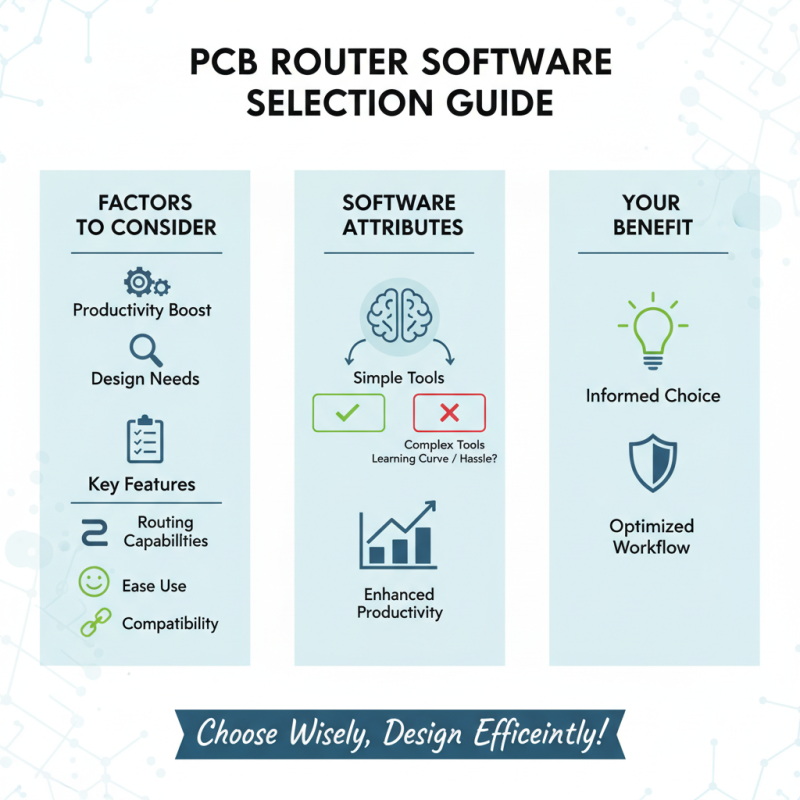
When choosing the best tooling for PCB design, many factors come into play. The right PCB router software can significantly enhance your productivity. Look for features that support your design needs. Check for routing capabilities, ease of use, and compatibility with other tools. Consider the learning curve associated with each software. Sometimes, a more complex tool may not be worth the hassle.

Tips: Always try a demo version first. This helps understand the interface better. A user-friendly tool can save time. Be aware that not all software versions have the same features. This can lead to confusion later.

Moreover, user preferences can often guide choices. Engaging in online forums may illuminate popular options. Some users may prefer more straightforward tools, while others might favor advanced options. Assessing your specific requirements is critical. Test multiple platforms before making a decision.

Remember, a well-chosen Pcb Board Router makes your design smoother. Don't rush the selection process. Take time to evaluate how each option aligns with your needs. A thoughtful approach will yield better results.

Comparative Analysis of PCB Router Tools: Performance Metrics

When selecting the best PCB router tools, performance metrics are crucial. Key factors include speed, accuracy, and ease of use. Recent industry studies show that the average routing speed can vary significantly. High-end tools might achieve speeds up to 15 meters per minute, while entry-level options only reach about 5 meters. This disparity affects design efficiency and time management.

Accuracy is another critical metric. Reports indicate that errors in routing can lead to costly rework. In fact, a study found that approximately 30% of PCB designs require revisions due to routing inaccuracies. Tools that offer precision down to 0.01mm greatly enhance reliability. However, not all users may fully exploit this feature, leading to potential oversights in design.

Ease of use cannot be underestimated. Some users struggle with complex software interfaces. A survey noted that 40% of designers found their router tools challenging to navigate. This often leads to underutilization of the Circuit Board Router's capabilities. While advanced features are appealing, they can hinder productivity for less experienced users. Understanding these performance nuances is essential for making informed choices in PCB design tools.

Cost-Benefit Assessment of Professional vs. Hobbyist PCB Routing Tools

When selecting PCB routing tools, it's essential to weigh professional options against those for hobbyists. Professional tools often come with advanced features. They provide precision and reliability, but the costs can be high. Hobbyist tools are typically more accessible and user-friendly. However, they may lack some advanced capabilities. Investing in pro tools can yield a quicker return on complex projects.

Consider your specific needs before making a choice. If you're a hobbyist, start with basic tools. They can help you learn and create functional designs without a big financial commitment. As your skills grow, you might feel the need for more advanced features. This evolution can justify the higher expense of professional tools.

Tip: Always assess the long-term value of any tool. A more expensive tool may save you time and improve quality. Evaluate how often you’ll use each tool. If you're unsure, try borrowing or renting to gauge whether it's worth the investment. Experiment with different tools for your workflow. You might find that certain features are more valuable than others.

Recent Technological Advancements in PCB Routing Tools: A Review

Recent advancements in PCB routing tools have significantly impacted the design process. Many engineers now rely on efficient software solutions to streamline their workflows. These tools incorporate features like automated routing and error detection. This helps reduce human error and optimize intricate designs. The precision offered by modern PCB routers ensures better performance.

However, not all tools are created equal. Some may lack user-friendly interfaces, making them hard to navigate. Engineers often find themselves spending too much time learning them. Additionally, certain features may not work as intended, leading to frustration and errors in design. The balance between functionality and usability needs more focus.

Despite these challenges, the potential of enhanced PCB routing tools is undeniable. They enable faster prototyping and iteration. Advanced simulations allow designers to test their ideas before physical production. Yet, it's crucial to continually assess these tools for improvement. Finding the right Pc Board Router can make all the difference in achieving optimal results.

Best Pcb Router Tools for Your PCB Design Needs - Recent Technological Advancements in PCB Routing Tools: A Review

Tool Name Routing Technology Features User Rating (out of 5) Price Range
Advanced PCB Router Automated Routing High-speed routing, Layer management, DRC checks 4.7 $200 - $400
Smart Route 2023 AI-assisted Routing AI optimization, Real-time simulation, Integration options 4.5 $150 - $300
Pro-Router X Hybrid Routing Manual and automated control, Advanced analytics tools 4.6 $250 - $450
Quick Route Pro Speed Routing Fast calculations, Intuitive interface, Customization options 4.4 $100 - $250
Precision Router Suite Precision Routing High precision, Advanced layer stackup, Design rule optimization 4.8 $300 - $600

Case Studies: Successful PCB Designs Utilizing Top Router Tools

When it comes to PCB design, choosing the right routing tool can make a significant difference. Many successful PCB projects highlight the importance of these tools in optimizing design efficiency. One notable case involved a tech company that reduced its design time by 30% using advanced routing capabilities. This allowed for quicker iterations and improved collaboration among team members.

Tips: Choose a router tool that offers various features. Look for customization options that fit your specific needs. A good match enhances productivity and creativity.

Another case featured a startup focused on wearable technology. They utilized a routing tool that allowed for complex multi-layer designs. This flexibility enabled them to pack functions into a compact space, leading to a more robust final product. However, they faced challenges during the layout phase, realizing some components were too close together. This taught them the value of thorough testing and revision.

Tips: Pay attention to spacing and layout. Proper component placement is crucial for performance. Design reviews can prevent costly mistakes before production.

FAQS

: What is the purpose of this service?

: This service aims to provide users with valuable information and assistance. Clear guidance helps users make informed decisions.

How can I access the information?

Users can access information through a website or a dedicated app. Simple navigation makes finding resources easy.

Is there a fee for using this service?

Most features are free, but some premium options may require payment. Always check for any hidden costs.

What types of information are available?

Information covers various topics, such as tips, advice, and insights. Different categories help users find relevant content quickly.

How often is the content updated?

Content is updated regularly to ensure accuracy and relevance. Users may sometimes encounter outdated information, requiring a check.

Can I provide feedback on the service?

Yes, user feedback is welcome and important. It helps improve the service and address any shortcomings or gaps.

What should I do if I encounter issues?

If problems arise, users can reach out to support for help. Response times may vary, so patience is needed.

Is my personal information safe?

User privacy is a priority, but risks always exist. Reviewing privacy policies helps users understand data handling practices.

Can I share the information?

Users may share relevant information, but restrictions could apply. Always consider copyrights or guidelines before sharing.

Are there alternative resources?

Yes, many alternatives exist, offering similar information. Exploring different sources can provide a broader understanding.

Conclusion

This article provides a comprehensive overview of PCB router tools, emphasizing their definitions, functions, and essential features that enhance performance in PCB design. It outlines the importance of selecting the right tools, which can significantly impact the efficiency and effectiveness of the routing process.

Furthermore, the article delves into a comparative analysis of various PCB router software, highlighting industry standards and user preferences. It also addresses the cost-benefit of professional versus hobbyist options, offering insights into recent technological advancements that improve PCB routing tools. Through case studies, the article illustrates successful PCB designs that have effectively utilized top router tools, showcasing their vital role in modern electronics development. Overall, understanding these aspects is crucial for designers looking to optimize their PCB routing capabilities.


Evelyn

Evelyn

Evelyn is a dedicated professional marketing specialist at Shenzhen Mole Electric Equipment Co., Ltd., where she leverages her expertise to effectively promote the company's innovative products. With a deep understanding of the industry, Evelyn focuses on delivering high-quality content that not......
Previous Mastering Smt Oven Reflow: A Comprehensive Guide for Global Buyers